

Germany is holding a national memorial day to commemorate the nearly 80,000 people who lost their lives to the COVID-19 pandemic in the country.
Earlier on Sunday Chancellor Angela Merkel and German President Frank-Walter Steinmeier attended a morning mass in the Kaiser Wilhelm Memorial Church, a Berlin landmark dedicated to peace and reconciliation.
“Sickness, dying and death cannot be just pushed away in this long year,” said George Baetzing, chairman of the German Bishops’ Conference, during the service. “They have cut deeply into the lives of many people.”
Merkel and Steinmeier are now taking part in a ceremony to be broadcast on public television in the Konzerthaus, a concert hall in central Berlin, where Steinmeier is due to give a speech.
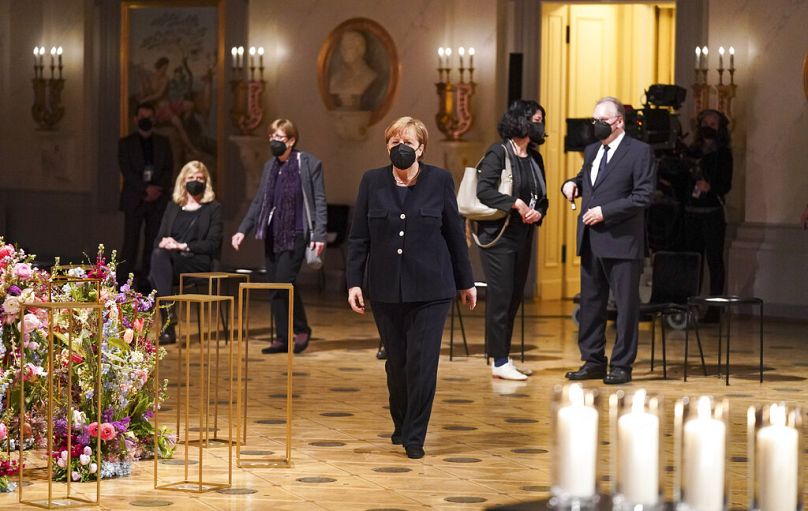
The number of guests has been limited due to the health crisis.
“It is very important to take a break and say goodbye in dignity to all those who died during the pandemic, including those who did not only succumb to the virus but also died in loneliness,” Steinmeier said when announcing the national commemoration.
People across the country were invited to take part by placing a lit candle in their window on the Saturday and Sunday evenings.
The commemoration comes as Germany battles the third wave of coronavirus infections, with newly recorded cases and deaths again on the rise. This has been blamed on the spread of new variants of SARS-CoV-2, which are thought to be more infectious than the original virus.
Germany’s confirmed death toll from COVID-19 stood at 79,914 on Sunday, an increase of 67 over the previous day. This was the fifth-highest total in Europe, after the U.K., Italy, Russia and France.
The Robert Koch Institute (RKI) has also warned that younger people — from age 15 to 49 — are now contracting the virus in higher numbers, which is putting further strain on the health system as “younger patients stay in intensive care units longer than older ones.”
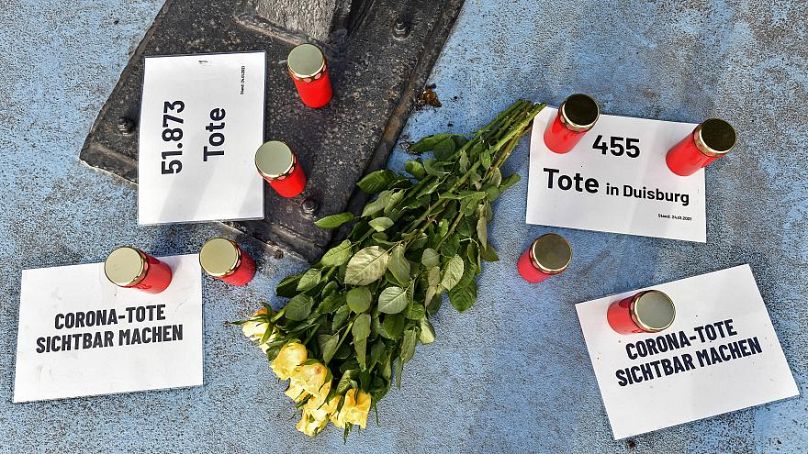
The number of seriously ill people aged over 80 has stabilised, however. This has been attributed to the rollout of vaccines; more than 21 million German residents have now received at least one dose of vaccine, and some 5.4 million are now fully inoculated.
Merkel appealed to federal lawmakers on Friday to back a bill that would see a uniform set of restrictions imposed across the country.
Currently, each region is able to mandate its own restrictions but the bill would force landers to impose the same measures, including nighttime curfews, the closure f ships and cultural and sports facilities, if the 7-day incidence rate reaches 100 cases per 100,000 population.
“The virus does not forgive half-measures, they only make it worse,” Merkel told lawmakers, describing the situation as “very serious”.
The Bundestag is to vote on the legislation next week.


