

Saturday, January 4
Thousands join Baghdad funeral for slain commanders
Thousands of Iraqis chanting “Death to America” joined the funeral procession on Saturday for Iranian commander Qasem Soleimani and Iraqi paramilitary chief Abu Mahdi al Muhandis, both killed in a US air strike.
The cortege set off around Kadhimiya, a Shia pilgrimage district of Baghdad, before heading to the Green Zone government and diplomatic compound where a state funeral was to be held attended by top dignitaries.
A prayer ceremony will be held at Baghdad’s al Kadhimiya Mosque before Muhandis’ body is sent to Najaf in the south for burial.
Soleimani’s body will be buried in the Iranian town of Kerman.
Iraqi militia retract fresh air strike statement
Iraq’s military denied on Saturday an air strike had taken place on a medical convoy in Taji, north of Baghdad.
Iraq’s Popular Mobilisation Forces umbrella grouping of paramilitary groups had said earlier that an air strike targeting its fighters hit a convoy of medics.
However, the PMF later issued another statement saying that no medical convoys were targeted in Taji.
They said that no strike took place.
The US confirmed it had not authorised any air strike in the region overnight.
Friday, January 3
Killing of Soleimani was to prevent war, not start one-Trump
President Donald Trump said on Friday he ordered the killing of Qasem Soleimani to stop a war, not start one, saying the Iranian military commander was planning imminent attacks on Americans.
“Soleimani was plotting imminent and sinister attacks on American diplomats and military personnel but we caught him in the act and terminated him,” Trump told reporters at his Mar-a-Lago resort.
“We took action last night to stop a war. We did not take action to start a war,” Trump said, adding that the United States does not seek regime change in Iran.
US deploying nearly 3,000 more troops to Mideast
The United States said on Friday it is sending nearly 3,000 more Army troops to the Mideast in the volatile aftermath of the killing of an Iranian general in a strike ordered by President Donald Trump.
Defence officials, who spoke on condition of anonymity to discuss a decision not yet announced by the Pentagon, said the troops are from the 82nd Airborne Division at Fort Bragg, North Carolina.
They are in addition to about 700 soldiers from the 82nd Airborne who deployed to Kuwait earlier this week after the storming of the US embassy compound in Baghdad by Iran-backed militiamen and their supporters.
Iraqi parliament to hold extraordinary session
Iraq’s parliament will hold an extraordinary session on Sunday to discuss the US air strike in Baghdad which killed Iran’s Quds Force leader Soleimani and Iraqi militia commander Muhandis, it said on Friday.
Prime Minister Adil Abdul Mahdi called on lawmakers to hold an emergency session and address the attack, which he called a violation of sovereignty.
Iran summons Swiss envoy again to answer US message
Iran summoned a Swiss envoy for a second time on Friday to deliver its answer to a US message, Iranian state media said, hours after a Swiss diplomat delivered Washington’s communication over the killing of Iranian Quds force chief Soleimani.
The Swiss envoy representing US interests in Tehran was summoned to the Foreign Ministry to receive the “proper” answer from Tehran, ministry spokesman Abbas Mousavi told state news agency IRNA, without giving further details.
 US senators to be briefed on Iraq operation
US Senate Republican leader Mitch McConnell said the Trump administration would brief congressional staff on Friday about the US military strike against Iranian military commander Soleimani and that it would likely conduct a classified briefing for all senators early next week.
“This terrorist mastermind was not just a threat to the United States and Israel. For more than a decade, he masterminded Iran’s malevolent and destabilising work throughout the entire Middle East,” McConnell said on the Senate floor as he urged senators to withhold judgment on the operation until they had received the facts.
Iran vows to avenge commander’s assassination
Iran’s top security body said on Friday the United States would be held accountable for killing Iranian Quds Force commander Qasem Soleimani, saying Washington’s action was its worst mistake in the region, Iranian media reported.
“The US regime will be responsible for the consequences of this criminal adventurism,” the Supreme National Security Council said in a statement carried by media outlets.
“This was the biggest US strategic blunder in the West Asia region, and America will not easily escape its consequences.”
Macron calls on Iran to refrain from provocation
French President Emmanuel Macron said on Friday that Iran should refrain from any provocation, speaking after a US air strike that killed a top Iranian commander in Iraq.
Macron also said in his statement that he had held talks with Russian President Vladimir Putin to discuss the situation in Iraq.
UN chief calls for maximum restraint
United Nations Secretary-General Antonio Guterres is deeply concerned by the recent rise in tensions in the Middle East, a spokesman said.
“The Secretary-General has consistently advocated for de-escalation in the Gulf. He is deeply concerned with the recent escalation,” said his spokesman, Farhan Haq, in a statement.
“This is a moment in which leaders must exercise maximum restraint. The world cannot afford another war in the Gulf.”
Turkey ‘deeply concerned’ about regional tension
The US air strike in Baghdad which killed Iranian commander Qasem Soleimani will “harm both the peace and stability of both Iraq and our region,” the Turkish Foreign Ministry said.
The ministry said such escalating steps that threaten stability in the region will increase the violence, “and all parties will suffer.”
“Turkey has always been against foreign interventions in the region, assassinations, and sectarian conflict,” it said.
Iraqi parliament speaker condemns US air strike
Iraq’s Speaker of Parliament Mohammed al Halbousi condemned on the US air strike in Baghdad as a “breach of sovereignty.”
“Yesterday’s targeting of a military commander in Iraq’s armed forces near Baghdad international airport is a flagrant breach of sovereignty and violation of international agreements,” he said in a statement.
“Iraq must avoid becoming a battlefield or a side in any regional or international conflict,” he added.
Halbousi, who as speaker is Iraq’s top Sunni Arab politician, called on the government to take all steps needed to stop such attacks.
Lebanon condemns Soleimani’s killing
Lebanon’s Foreign Ministry on Friday called for the country and wider region to be spared any repercussions from the Quds Force commander’s death.
The ministry also condemned the killing, calling it a violation of Iraqi sovereignty and a dangerous escalation against Iran.
Iran never won a war, but never lost a negotiation!
— Donald J. Trump (@realDonaldTrump) January 3, 2020
Iran never won a war – Trump
US President Donald Trump said that Iran never won a war, in the wake of the killing of a top Iranian commander.
“Iran never won a war but never lost a negotiation,” Trump said on Twitter.
Trump said Qasem Soleimani was plotting to kill many more Americans.
Egypt appeals against escalation in Iraq
Egypt’s Foreign Ministry said it was following developments in Iraq with great concern and appealed against any further escalation.
“The Foreign Ministry is following with great concern accelerating developments in Iraq, which augur an escalation important to avoid,” the statement said.
“For this reason, Egypt calls for containing the situation and avoiding any escalation.”
Tens of thousands rally in Iran to protest US ‘crimes’
Tens of thousands of people took to the streets of Tehran to protest against US “crimes.”
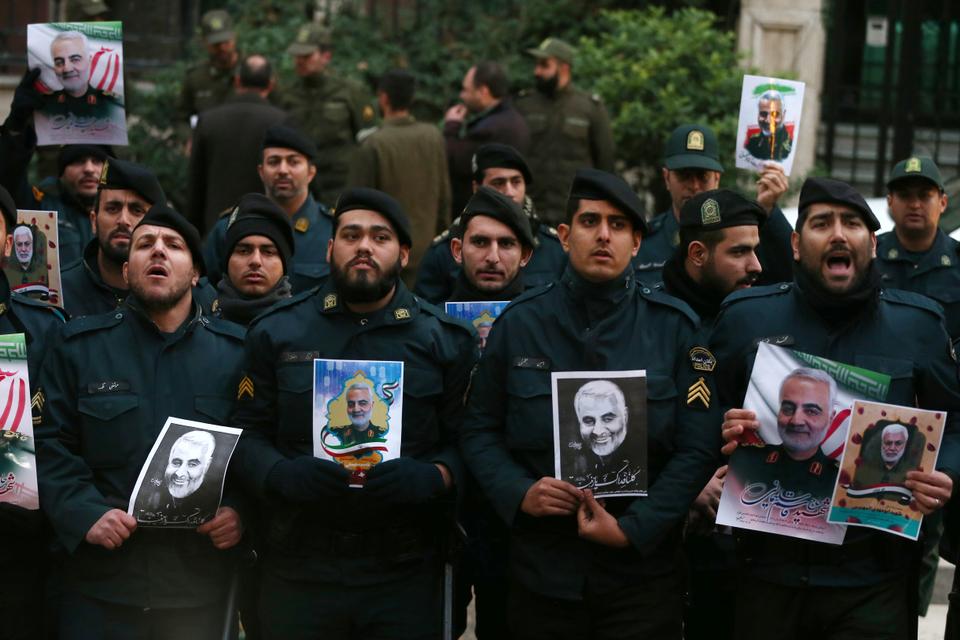
Chanting “Death to America” and holding up posters of the slain top Iranian commander Soleimani, the demonstrators filled streets for several blocks in central Tehran after Friday prayers.
State news agency IRNA said there were similar demonstrations in the cities of Arak, Bojnourd, Hamedan, Hormozgan, Sanandaj, Semnan, Shiraz, and Yazd.
News of the death of Soleimani, one of Iran’s most popular public figures, also saw people hold impromptu gatherings in his central hometown of Kerman.
 De-escalation with Iran possible – Pompeo
Washington is committed to “de-escalation” after the killing of Soleimani, Secretary of State Mike Pompeo said on Friday.
Pompeo said on Twitter that he spoke to British Foreign Minister Dominic Raab and China’s top diplomat Yang Jiechi about the US decision to kill Soleimani.
US has right to self-defence – Netanyahu
“Just as Israel has the right of self-defence, the United States has exactly the same right,” Israeli Prime Minister Benjamin Netanyahu said in a statement issued by his office.
“Qasem Soleimani is responsible for the death of American citizens and many other innocent people. He was planning more such attacks.”
Esmail Qaani new Quds chief after Soleimani killing
Iran’s supreme leader Ayatollah Ali Khamenei appointed Esmail Qaani as the new head of the Revolutionary Guard’s foreign operations arm.
“Following the martyrdom of the glorious general haj Qasem Soleimani, I name Brigadier General Esmail Qaani as the commander of the Quds Force of the Islamic Revolutionary Guard Corp (IRGC).”
Act of aggression on Iraq – PM Abdul Mahdi
The air strike on Baghdad airport is an act of aggression on Iraq and a breach of its sovereignty that will lead to war in Iraq, the region, and the world, Prime Minister Adil Abdul Mahdi said in a statement.
“Liquidation operations [assassinations] of leading Iraqi officials or from a friendly country on Iraqi soil is a brazen violation of Iraq’s sovereignty and blatant attack on the nation’s dignity,” he said.
The strike also violated the conditions of US military presence in Iraq and should be met with legislation that safeguards Iraq’s security and sovereignty, Abdul Mahdi added.
US citizens urged to depart Iraq
The US embassy in Baghdad urged all citizens to depart Iraq immediately, hours after the US killed Soleimani and Muhandis in an air strike.
“Due to heightened tensions in Iraq and the region, the US Embassy urges American citizens to heed the January 2020 Travel Advisory and depart Iraq immediately. US citizens should depart via airline while possible, and failing that, to other countries via land,” it said in a statement.
France says world ‘more dangerous’
The world is “more dangerous,” France’s Europe minister said, calling for efforts to de-escalate the deepening conflict in the Middle East.
“We have woken up to a more dangerous world,” Amelie de Montchalin told RTL radio, saying President Emmanuel Macron would consult soon with “players in the region.”
China urges ‘calm and restraint’
China appealed for restraint from all sides, “especially the United States.”
“China has always opposed the use of force in international relations,” Chinese Foreign Ministry spokesman Geng Shuang said at a daily press briefing.
Moscow warns of increasing tensions
Moscow warned on Friday that Soleimani’s assassination would boost tensions across the Middle East.
“The killing of Soleimani … was an adventurist step that will increase tensions throughout the region,” news agencies RIA Novosti and TASS quoted the Foreign Ministry as saying.
“Soleimani served the cause of protecting Iran’s national interests with devotion. We express our sincere condolences to the Iranian people.”
‘A gruesome crime’ – Rouhani
Iran and the “free nations of the region” will take revenge on the US for killing Soleimani, President Hasan Rouhani said.
“There is no doubt that the great nation of Iran and the other free nations of the region will take revenge for this gruesome crime from criminal America,” Rouhani said, referring to Iran’s allies across the Middle East.
Soleimani’s “martyrdom … by the aggressor and criminal America has saddened the heart of the nation of Iran and all the nations of the region,” he said in a statement posted on the Iranian government website.
Declaring three days of mourning across the country, Iran’s Khamenei vowed to take “severe revenge” for 62-year-old Soleimani’s death.
Iran’s Foreign Minister Mohammad Javad Zarif slammed the US strike as “extremely dangerous and a foolish escalation.”
Top official Mohsen Rezai pledged to “exact terrible vengeance upon America,” and Tehran’s top security council said it would hold an urgent meeting.
The US’ act of international terrorism, targeting & assassinating General Soleimani—THE most effective force fighting Daesh (ISIS), Al Nusrah, Al Qaeda et al—is extremely dangerous & a foolish escalation.
The US bears responsibility for all consequences of its rogue adventurism.
— Javad Zarif (@JZarif) January 3, 2020
Sistani calls US Iraq strike ‘wanton attack’
Iraq’s top Shia cleric Grand Ayatollah Ali Sistani condemned the US air strike, calling it a “wanton attack” on the country.
In his weekly sermon delivered by his representative in the Shia holy city of Karbala, Sistani said the raid amounted to a “blatant violation of Iraqi sovereignty.”
Iraq’s Sadr mourns Soleimani
Iraqi Shia cleric Moqtada al Sadr mourned Soleimani’s assassination, saying his militias were ready to defend Iraq.
“As the patron of the patriotic Iraqi resistance I give the order for all mujahideen, especially the Mehdi Army, Promised Day Brigade, and all patriotic and disciplined groups to be ready to protect Iraq,” he said in a statement.
Sadr, who positions himself as a nationalist rejecting both US and Iranian interference in Iraq, however, called on all sides to behave with “wisdom and shrewdness.”
Will Iran retaliate? Experts speculate
“In terms of a decapitation strike, what just happened is the most major decapitation strike that the US has ever pulled off,” said Phillip Smyth, a US-based specialist in Shia armed groups.
He said it would have “bigger” ramifications than the 2011 US operation that killed Al Qaeda chief Osama bin Laden and the 2019 American raid that killed Daesh leader Abu Bakr al Baghdadi.
“There is no comparison,” he added.
But others said it remains unclear how Iran could respond to the blow.
“A lot of the focus is on what is the price that the US is gonna pay and how Iran will retaliate against the US,” said Fanar Haddad of the Singapore University’s Middle East Institute.
Journalist and Middle East analyst Soraya Lennie has more.
US Congress not informed of Iraq strike
US lawmakers, however, were not told in advance of Friday’s attack, House Foreign Affairs Committee chairman Eliot Engel said in a statement.
“Tonight’s air strike risks provoking further dangerous escalation of violence. America – and the world – cannot afford to have tensions escalate to the point of no return,” US House of Representatives Speaker Nancy Pelosi.
“The Administration has conducted tonight’s strikes in Iraq without an Authorization for Use of Military Force (AUMF) against Iran. Further, this action was taken without the consultation of the Congress,” Pelosi said.
Ties between the US and Iran have deteriorated since Washington pulled out of the landmark nuclear deal with Tehran in 2018.
It then reimposed crippling sanctions on Iran, aiming to choke off its oil exports.
Oil prices soar
Oil prices soared following Friday’s attack, with Brent surging 4.4 percent to $69.16 and WTI jumping 4.3 percent to 63.84.
The attack threatens to destabilise Iraq, which has close political and military ties with both Tehran and Washington.
The US led the 2003 invasion against then-dictator Saddam Hussein and has worked closely with Iraqi officials since.
But its influence has waned compared with that of Tehran, which has carefully crafted personal ties with Iraqi politicians and armed factions, even during Saddam’s reign.
Iraqi officials have warned in recent months that their country could be used as an arena for score-settling between Iran and the US.
What is the Hashd?
The Hashd al Shaadi is an Iraqi paramilitary force with close ties to Iran. It is also known as the Popular Mobilisation Units.
The Hashd is a network of mostly-Shia armed units, many of whom have close ties to Tehran, but which have been officially incorporated into Iraq’s state security forces.
The units joined forces to fight Daesh group in 2014, after many of them built up years of fighting experience during Iraq’s war years, including against the US.
Strike near Baghdad airport
Trump tweeted out a picture of the US flag without any explanation, as the pre-dawn developments marked the most major escalation yet in a feared proxy war between Iran and the US on Iraqi soil.
Early Friday, a volley of missiles hit Baghdad’s international airport, striking a convoy belonging to the Hashd al Shaabi.
Just a few hours later, the IRGC announced Soleimani “was martyred in an attack by America on Baghdad airport this morning.”
The Hashd confirmed both Soleimani and Muhandis were killed in what it said was a “US strike that targeted their car on the Baghdad International Airport road.”
The Pentagon said Soleimani had been “actively developing plans to attack American diplomats and service members in Iraq and throughout the region.”
It said it took “decisive defensive action to protect US personnel abroad by killing Qasem Soleimani,” but did not specify how.
US officials, speaking on the condition of anonymity, said that Soleimani had been killed in a drone strike in Baghdad.
US Secretary of State Mike Pompeo tweeted that Iraqis are dancing in the street after Soleimani’s death.
Iraqis — Iraqis — dancing in the street for freedom; thankful that General Soleimani is no more. pic.twitter.com/huFcae3ap4
— Secretary Pompeo (@SecPompeo) January 3, 2020
Iran’s Qasem Soleimani killed in US strike
Soleimani was killed in a US strike on Baghdad’s international airport, Iran and the US confirmed, in the most dramatic episode yet of escalating tensions between the two countries.
The Pentagon said Trump ordered Soleimani’s “killing,” after a pro-Iran mob this week laid siege to the US embassy in Baghdad.
A mob of Hashd al Shaabi supporters surrounded the US embassy on Tuesday in outrage over American air strikes that killed 25 fighters from the network’s hardline Kataib Hezbollah faction, which is backed by Iran.
The US had acted in response to a rocket attack days earlier that had killed an American contractor working in Iraq.
Trump had blamed Iran for a spate of rocket attacks targeting US forces as well as the siege at the embassy, saying: “They will pay a very BIG PRICE! This is not a Warning, it is a Threat.”
Soleimani was a top general in Iran’s Revolutionary Guard Corps and the leader of the elite Quds Force.
He also served as Iran’s point man on Iraq, visiting the country in times of turmoil.
Hashd al Shaabi or Iraq’s paramilitary Popular Militarisation Units deputy chief Abu Mahdi al Muhandis was also killed in the strike.
Muhandis was the Hashd’s deputy chief but widely recognised as the real shot-caller within the group. He was also the founder of the Kataib Hezbollah.
Both were sanctioned by US.


