

Michel Barnier has told MEPs there remain insufficient grounds for reopening formal negotiations over the Irish backstop, six months after Theresa May and the European commission closed them.
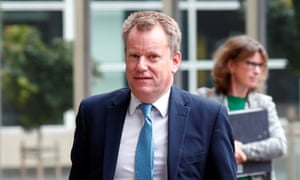
In a private briefing with the European parliament’s leaders, the EU’s chief negotiator said Boris Johnson’s officials, led by his envoy, David Frost, were yet to offer any credible plan on which the two sides could build.
“We will see in the coming weeks if the British are able to make concrete proposals in writing that are legally operational,” Barnier told the MEPs. “While we have previously reached an agreement, as far as we can speak [today], we have no reason to be optimistic … I cannot tell you objectively whether contacts with the government of Mr Johnson will be able to reach an agreement by mid-October.
Barnier said there had been a willingness by the UK to “intensify contacts” but that in terms of replacing the backstop “the ball is clearly in the British camp” and “the Brexit situation remains serious and uncertain”.
Barnier’s comments, published in full by the European commission, are the clearest indication so far of the lack of progress being made in the talks in Brussels, where the prime minister has insisted a major renegotiation is in process.
The EU negotiator said Johnson had claimed on becoming prime minister that he was “ready for an exit without agreement if his requests were not accepted, as if this prospect could lead us to give up our principles”, but that the Commons had “rejected such a scenario”.
 “At the same time, you will have understood, despite the vote of the extension law, the risk of no deal has not been ruled out,” Barnier said. “A no deal will never be the choice of the union. But we do not have the ability to avoid this scenario alone.”
The EU’s negotiator went on to raise concerns about the UK’s plans for the future trade relationship, which he suggested amounted to an attempt to undercut the European economic model by becoming a Singapore-on-Thames.
Barnier told the MEPs: “On our future economic partnership, they want us to state without ambiguity that the final destination must be a free trade agreement and in no way a customs union. And we are obviously ready to work in this direction.
“We will have a problem if the British will at the same time challenge the level playing field commitments we have negotiated with Mrs May and which guarantee fair competition between the EU and the UK. This is of course a point on which we will remain very vigilant.
“It is clear that the level of ambition of a future free trade agreement will be defined according to the guarantees given by the United Kingdom in terms of state aid, taxation or social and environmental standards, given its economic size and proximity.”
In an earlier briefing with diplomats representing the EU27 about the latest talks with Frost, a senior member of Barnier’s Brexit team had described the ideas so far put forward during technical talks between officials on both sides as aspirational.
“Another longish meeting without tangible progress on Wednesday,” said an EU diplomat, referring to the latest round of talks between the European commission and Frost.
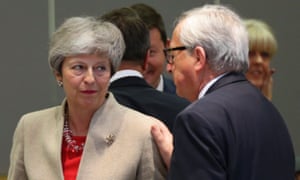
The last substantive Brexit negotiation took place in Strasbourg in March when May and the European commission president, Jean-Claude Juncker, drafted an ill-fated adjunct to the withdrawal agreement emphasising the temporary nature of the Irish backstop. May’s deal was subsequently defeated in the Commons by the crushing margin of 149.
 EU officials insisted that nearly two months after Johnson was made prime minister the gap between the two sides was still far too wide for any meaningful renegotiation and that British civil servants were still merely “talking about concepts”.
In the most recent talks between officials, Frost was said to have outlined ideas covering customs and manufactured goods in which Northern Ireland and the Republic of Ireland would be in separate customs and regulatory zones.
Sources said Johnson’s envoy had suggested an “enhanced market surveillance mechanism” for industrial goods involving tough penalties for those who seek to smuggle contraband over the border.
Frost had said the UK could commit to an open border in the withdrawal agreement but that the detail of how checks could be done away from the border would have to be decided during the stand-still transition period catered for in the withdrawal agreement.
 The EU says there must be a legally operable plan for avoiding a hard border on the island of Ireland in any withdrawal agreement and it will not accept a deal based on a promise.
Speaking after the MEPs’ briefing with Barnier, the president of the European parliament, David Sassoli, told reporters: “We would like there to be initiatives to discuss but unfortunately there aren’t any.”
The UK government says it will not accept any backstop that leaves Northern Ireland in a separate customs territory and different regulatory areas for goods other than agrifood. There remains some confidence that the UK might move in that direction in order to put a last-gasp deal before parliament and avoid a further Brexit extension.
One diplomat said the UK “now seems [to better] recognise the unique situation on the island of Ireland”, but that current proposals were “wish-wash”.


